S L O V E N I A
0. INTRODUCTION *
Geographically, commercially and historically, Slovenia is located at the very central point of the European countries - where the Alps, the Pannonian Plain and the Adriatic Sea converge, where the main European commercial roads cross, where history has created and preserved rich and diverse cultural heritage.
This central location within Europe has been responsible for many historical, political, economic and cultural developments in the country; furthermore, it affects also the present political and cultural situation. The beginnings of the Slovene history date back to the 6th century, when the "Kingdom of Carinthia" (not the same as Carinthia, the southern province of Austria) was formed. From then on, Slovenia has never been established, in any political form, as a sovereign country. Nevertheless, as a national and cultural entity, the Slovenes have played an important role as part of the Roman, German and Austrian Empires, and, in the past 70 years, as part of Yugoslavia.
In 1991, Slovenia, like the other young, newly-formed sovereign countries of Eastern and Central Europe (the former Soviet Union, Czechoslovakia, Yugoslavia), established its own political structure. The Basic Constitutional Charter on the Independence and Sovereignty of the Republic of Slovenia was proclaimed on 25 June 1991, and the Constitution of the Republic of Slovenia was promulgated on 23 December 1991.
The Republic of Slovenia is among the smallest countries in Europe. The total land area of 20,256 km2 is inhabited by a population of 1,95 million (1997); the population density is almost 100 people per square kilometre. Thirty per cent of the population lives in cities with more than 20,000 inhabitants. The lower administrative level comprises 62 municipalities and 1,206 local communities.
More than 87.7 per cent of the population are Slovenes; 0.5 per cent are Hungarians and 0.16 per cent are Italians (two indigenous ethnic groups enjoying an especially protected political and cultural status); around 10 per cent are economic immigrants from the former Yugoslavia; and 0.1 per cent are members of the culturally protected Gypsy ethnic group. About a quarter of all Slovenes will be found outside the Republic of Slovenia: as autochthonous communities in Italy, Austria and Hungary, or as Slovenian emigrants in Europe and overseas.
1. GENERAL DIRECTIONS OF CULTURAL POLICY
Cultural policy is an important part of the global policy of the Republic of Slovenia, directing its cultural development and the building of its national identity. The attainment of independence, the transition from an ethnic group to a nation, the establishment of a state making a clear break with the real-socialist cultural policy - all these require an essentially new definition of the position of culture and the arts in Slovenia, a new definition of cultural policy, a new model of cultural organisation, decision-making, administration and management, and new legislation in the cultural sphere. The cultural policy of Slovenia, with its instruments, measures and legislation, secures the conditions and the funds for cultural activities, and makes possible Slovenia's incorporation into different international cultural organisations and institutions, seeking to achieve two purposes:
- internally - spiritual freedom of the individual and the nation as a whole;
- externally - promotion of Slovene culture in Europe.
Slovenia's Constitution is based on "human rights and privileges and on the basic and unlimited right of the Slovenian nation to self-determination..." (The Basic Constitutional Charter on the Independence and Sovereignty of the Republic of Slovenia). The Slovene state was established on the basis of the separation of legislative, executive and judiciary powers.
The Constitution of the Republic of Slovenia guarantees all human, economic, social, and cultural rights. Slovenia is defined as a democratic, legal, and social state of all its citizens. "On its territory, the state shall protect and safeguard the rights of the Hungarian and Italian ethnic groups" (Articles 5 and 64). "Slovenia shall look after the interests of the Slovenian minorities in neighbouring countries and of Slovenes in emigration" (Article 5). The right of expression of national and cultural membership (Article 61) and the right to use the native language, in speech and writing, is guaranteed (Article 62).
The Constitution guarantees "the freedom of scientific and artistic creativity" (Article 59). The protection of moral, material and other rights, as a result of scientific, intellectual, cultural, artistic, and other creativity, is guaranteed (Article 60). The state and the municipalities protect the natural and cultural heritage (Article 73). The freedom of expression of thought, speech and appearance in public, printing, and other forms of public communication are guaranteed (Article 39). The rights of peaceful assembly and public rallies are guaranteed (Article 42).
The model of administration is such as to guarantee the autonomy of culture. At the same time, cultural policy, as part of the global national policy, is strengthened.
The principles and methods, objectives and aims of Slovenia's cultural policy are presented to Parliament each year as the Republic's Programme of Culture, prepared by the Ministry of Culture. "Influenced by sovereignty, the new Constitution, international recognition, and a definite farewell to Yugoslavia, the new Slovenian cultural policy was established. Some basic starting policies of cultural development, as presented to the Parliament of the Republic of Slovenia, have now come to fruition. The paradigm of a dynamic equivalence, embracing different artistic, philosophical, natural, geographical, sociological, and cultural spheres, has become evident, in accordance with the spirit of the time. Two constant principles remain stable regardless of possible political changes - the principle of democratisation and the principle of rationalisation. Cooperating with other authorized bodies, the Ministry of Culture, an expert flexibly organized executive organ, executes the national cultural policy."
2. ADMINISTRATIVE AND INSTITUTIONAL STRUCTURES
2.1 Public and semi-public bodies
A new administrative and institutional structure of Slovenian cultural policy is being established along the following lines:
- The overall cultural policy and legislation in the cultural sphere are formulated by the Parliament of the Republic of Slovenia.
- The Ministry of Culture assumes responsibility for the functioning of administration and management, and not for leadership and direction.
- The National Council for Culture is attached to the Ministry of Culture. It is nominated by the Parliament of the Republic of Slovenia on the proposal of the Slovenian Cultural Assembly and the Ministry of Culture. The National Council for Culture is a competent public body consisting of 18 experts and cultural managers, half of them nominated by the Ministry of Culture. The National Council for Culture manages the Culture Fund, which is endowed by patrons, donors and sponsors. Another fund, the Fund for the Promotion of Slovenian Culture Abroad, is managed by the Agency for the Promotion of Slovenian Culture, or actually, by the Committee of the Fund numbering seven prominent personalities from the field of culture, the arts and cultural management, nominated by the Parliament of the Republic of Slovenia.
- The Parliamentary Committee for Culture and the Preservation of Cultural Heritage discharges its function according to parliamentary regulations; it also serves as a link between the Parliament and the Slovenian Cultural Assembly.
- The Slovenian Cultural Assembly is developing overall principles of cultural policy, cultural legislation, and the Republic's Programme of Culture.
As the highest executive body, the Ministry of Culture puts the cultural policies into effect with the support of its various departments and expert sectorial services. The Ministry of Culture is responsible for the following:
- planning and development of legislation and regulations important for culture,
- realisation of national cultural development plans,
- planning of complex programmes and cultural actions at the national level,
- establishment of contacts with partners,
- supervision and control of the realisation of cultural programmes and actions,
- preparation of annual reports on cultural activities in the Republic,
- development of short- and long-term objectives and aims of cultural policy.
In performing the above tasks, the Ministry of Culture cooperates with the National Council for Culture and the appropriate parliamentary committees.
The internal organisational units of the Ministry of Culture comprise the following departments:
- Department for the Protection of Natural and Cultural Heritage,
- Department for Cultural Creativity (theatre, RTV, fine arts, publishing, libraries, film, employment policy, education, funding),
- Department for the Development and Implementation of the System of Evaluation in Cultural Activities,
- Department for the Promotion of Slovene Culture at home and abroad,
- Legal and Administrative Department,
- Secretarial services.
2.2 Facilities and institutions
The most important institutions and facilities for the implementation of Slovenia's cultural policy are the following:
Cankarjev Dom Cultural and Congress Centre in Ljubljana (member of the International Association ISPAA), with a large concert hall, a theatre hall, and two smaller halls, built in 1981;
Krizanke Cultural and Information Centre;
Ljubljana Dance Theatre;
Fund of the Republic of Slovenia for Development;
Institute of the Republic of Slovenia for International Cooperation (ZAMTES);
Institute of the Republic of Slovenia for the Protection of Natural and Cultural Heritage;
International Graphics and Fine Arts Centre at Tivoli Castle in Ljubljana, organizers of an important graphics biennale;
Maribor Cultural Forum, Association of Cultural Workers;
Network for Metelkova Street, a movement set up to acquire the former army barracks and convert them into art studios, the whole complex evolving into a focal point of alternative and independent cultural life in Ljubljana;
Network of the Association of Cultural Organisations of Slovenia (ZKOS), promoting amateur art, with an important educational role in its local cultural centres;
The circle around the New Review (Nova Revija) literary journal and the Society of Slovenian Writers; the journal occupies a special place in the periodical press, presenting and featuring the contemporary Slovenian literary creativity and cultural policy;
Rembrandt Society, Rembrandt Agency for Fine Arts, and Rembrandt Foundation;
Society for Improving the Cultural Image of the Old Part of Ljubljana;
Slovenian Academy of Sciences and Arts in Ljubljana;
Slovenian Theatre Association; etc.
3. INSTRUMENTS OF CULTURAL POLICY
3.1 Financing of cultural activities
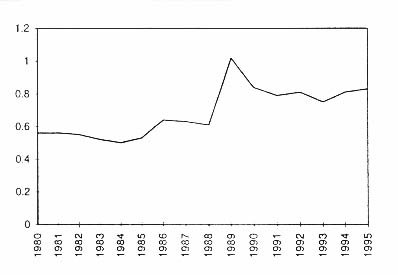
In the eighties, the Republic of Slovenia spent 0.64 per cent of its gross national product on culture. In 1989, the share was 1.02 per cent, but it has been declining since then because of economic difficulties, dropping to 0.95 per cent in 1990, 0.75 per cent in 1991, and 0.72 per cent in 1992.
Public spending on culture is financed from two main sources: funds of the Ministry of Culture, which provides 60-70 per cent of the total spending on culture, and municipal funds, which provide the rest. The financial situation in culture has substantially changed since 1990, when the municipalities provided more than 50 per cent of the funds (participating more actively in the Republic's cultural programme and covering the entire municipal cultural life).
Table 1: Payments from the republic programme of culture for cultural activities and investments in culture (in US $ thousands)
Year |
Total programme of culture |
Cultural activities and institutions |
Investments |
Administrative costs |
|||||
Regular activities |
Individual projects and programmes |
||||||||
% |
% |
% |
% |
||||||
1984 |
12 093 |
4 600 |
38.0 |
5 812 |
48.1 |
1 419 |
11.7 |
262 |
2.2 |
1985 |
13 140 |
5 119 |
39.0 |
5 899 |
44.9 |
745 |
5.7 |
310 |
2.4 |
1986 |
24 649 |
14 249 |
57.8 |
5 788 |
23.5 |
3 718 |
15.1 |
525 |
2.1 |
1987 |
34 298 |
16 373 |
47.7 |
12 410 |
36.2 |
4 660 |
13.6 |
612 |
1.8 |
1988 |
32 929 |
15 794 |
48.0 |
12 127 |
36.8 |
4 354 |
13.2 |
654 |
2.0 |
1989 |
62 297 |
22 466 |
36.1 |
19 743 |
31.7 |
11 588 |
18.6 |
1 740 |
2.8 |
1990 |
102 855 |
57 924 |
56.3 |
30 306 |
29.5 |
14 365 |
14.0 |
260 |
0.3 |
1991 |
66 920 |
39 549 |
59.1 |
21 462 |
32.1 |
5 376 |
8.0 |
533 |
0.8 |
1992 |
66 122 |
45 624 |
69.0 |
15 358 |
23.2 |
4 437 |
6.7 |
704 |
1.1 |
1993 |
65 134 |
44 416 |
68.2 |
15 721 |
24.1 |
3 948 |
6.1 |
960 |
1.5 |
1994 |
78 387 |
51 926 |
66.2 |
20 523 |
26.2 |
5 003 |
6.4 |
934 |
1.2 |
1995 |
105 690 |
69 848 |
66.1 |
26 387 |
25.0 |
7 761 |
7.3 |
1 694 |
1.6 |
1996 |
110 593 |
74 185 |
67.1 |
26 935 |
24.4 |
7 993 |
7.2 |
1 479 |
1.3 |
In the present system of financing and subsidy, the principle of equivalence prevails in a situation of low budgetary expenditure. This leads to the levelling of cultural/artistic achievement and stimulation of a low average. The new cultural policy does, however, provide for the stimulation of top-level cultural achievement from the Republic's reserve funds, or from the Cultural Fund.
Graph 1: Share of state public cultural expenditure in GDP
Financially, the Republic supports culture and the arts in Slovenia in the following ways:
- full financing of cultural institutions,
- subsidizing of cultural activities,
- subventions for individual cultural projects,
- Pension Fund and disability insurance for individual artists,
- cultural investments,
- infrastructure and equipment for cultural institutions.
The Ministry of Culture finances fully 76 central cultural organisations and covers part of the cost of regular activities of institutes of public cultural interest.
The Republic Fund of the Ministry of Culture makes possible the implementation of the Republic Programme of Culture and programmes arranged in conjunction with municipal funds for culture. The criteria for the budgetary distribution of funds, according to cultural activities, are recommended to the Republic by the National Council for Culture and the Ministry of Culture.
Table 2: Household consumption by goods and services (%)
1984 |
1988 |
1991 |
1994 |
|
| books | 12.1 |
13.0 |
10.8 |
14.0 |
| newspapers and magazines | 31.0 |
32.8 |
38.5 |
36.6 |
| radio sets | 1.7 |
1.6 |
0.5 |
0.6 |
| stereo equipment | 4.3 |
2.0 |
2.1 |
2.1 |
| TV sets | 12.4 |
13.8 |
5.7 |
4.6 |
| musical instruments | 2.2 |
0.7 |
1.0 |
0.8 |
| music records | 1.2 |
1.0 |
1.3 |
2.3 |
| cinema tickets | 3.4 |
3.4 |
2.6 |
4.6 |
| theatre,concert tickets | 1.8 |
1.8 |
1.8 |
2.5 |
| radio and TV subscription | 29.9 |
29.9 |
35.7 |
31.7 |
The sphere of cultural legislation has been marked by an interregnum.
The legislative formulations and principles of cultural policy are still those of the former real-socialist political system embodied in the Regulation of the Cultural Sphere (Ljubljana, 1985), i.e. cultural legislation based on the constitutional and legal tenets of the former Constitution. Losing its substantive underpinnings, the old legislation is simply fading away. Yet it is completely new only in respect of the model of management of cultural policy and in terms of complete deregulation in the field of cultural and artistic creation. In other areas only those changes connected with the abolition of anonymous social ownership and the self-management model have been made. However, some important new laws have been promulgated:
- Law on General Cultural Policy,
- Law on the Financing of Cultural Activities,
- Law on Independent (Self-Employed) Cultural Workers,
- Law on Copyright,
- Law on the Protection of Natural and Cultural Heritage, etc.
The problem of competences between the Republic and local authorities has not yet been resolved (it has to do with the relations between the founders of cultural institutions and the subsidy-giver). The principle of centralism and polycentrism has been replaced by the principle of decentralisation and subsidiarity.
Reforms and revitalisation are in progress. The new legislation, practically in use though not yet promulgated, consists of two main laws:
- a general law on the cultural sphere:
- a system of regulations on culture and a model of administration based on the constitutional principle of separation of legislative, executive and judiciary powers and the participation of professional public and civil society in cultural administration,
- a system of public financing of culture;
- special laws on particular cultural activities:
- protection of natural and cultural heritage,
- cultural/artistic creativity,
- mediation of cultural goods.
A new sales tax law was introduced (February, 1992), initiating a new system of paying the sales tax. According to the new regulation of the cultural sphere, only museums and archives and authors of creative works of art are fully exempt from the sales tax. Many cultural businesses (including publishing) enjoy a tax relief and pay a reduced sales tax of 5 per cent.
The term cultural heritage covers museums, archival institutions, historic sites and archaeological monuments, and zoos.
The medium-term plan of restoration of the nation's "Building Heritage", i.e., cultural property (96 religious buildings, 66 manors and castles, 57 ethnological sites, and 39 nature sites) is one of the priorities of the Slovenian cultural policy. The Ministry of Culture subsidizes 50 per cent of all reconstructions in Slovenia, as well as 18 important buildings and different open museums.
The sphere of natural and cultural heritage is covered, since 1991, by the Republic's Institute for the Protection of Natural and Cultural Heritage, attached to the Ministry of Culture, and by a network of 7 regional institutes. The regulative activities are the responsibility of the state (public) administration. Therefore, the Republic's Institute and the Archives of the Republic of Slovenia come under the Ministry of Culture. The operational activities, which are the responsibility of the municipalities, are carried out by a network of local institutes, museums and archives. Recently the responsibility for nature protection and conservation has been transferred to the Ministry of the Environment.
The Republic of Slovenia has 40 museums, 65 museum branches and extensions, and 74 museum collections, which together hold 879,601 exhibits (14.4 per cent more than in 1988). In 1991, there were about 1 million visitors (50.3 per cent of them group visits by pupils and students). The museums and museum collections had 606 employees. In comparison with 1988, the activity of the museums had decreased and the number of visitors declined by half.
Legally, the museums operate either as independent institutions or within the structure of other cultural institutes. The Law on Cultural Activities and the accompanying Governmental Decree on Museum Activities are in process of being changed. A new museum network and a new system of information are going to be established. In Slovenia, archives are specialized institutions engaged in the protection of archival materials and cultural heritage. Archival activities are regulated by the Law on the Protection of Natural and Cultural Heritage and the Law on Archives.
In 1990, there were 8 archives in Slovenia (7 independent and 1 at the Institute of Recent History), 827 private archival funds, and 264 collections. Altogether, in 1995 the archives occupied 15,610 square meters and archive material numbered 42,367 meters. The number of employees was 186.
4.2 Cultural education and training
N/A
Of all the public funds for culture allocated from the state budget, about 15 per cent is spent on the theatre and 16.5 per cent on music and dance. Some 90 per cent of the money available for the theatre is spent on 11 permanent professional theatres (the Slovene National Theatre in Ljubljana and the Slovene National Theatre in Maribor are the best known among them). The remaining 10 per cent is divided as follows: 1.5 per cent for independent theatre productions, 3 per cent for theatre festivals, and the remaining 5.5 per cent for theatre tours in the country and abroad, for the maintenance of theatre buildings, and activities of theatre associations.
The state subsidy accounts for about 90 per cent of the revenue income of the state-financed theatres, which is more than the European average, which amounts to some 70 per cent. The remaining 10 per cent is obtained from the sale of tickets and publications, as well as from sponsorship. Amateur and semi-professional theatre activities are mainly financed from municipal funds.
It is obvious from the breakdown of spending of theatre funds given above that the most neglected area are projects of independent (alternative) theatre production, despite their very high artistic level and international reputation (16 per cent of all Slovenian performances abroad). The Ministry of Culture occasionally supports the costs of first-night performances of some independent theatre projects, while the costs of regular performances are not covered.
Turning to the distribution of funds for music and dance (16.5 per cent of all public funds for culture), 90 per cent is spent to finance the regular activities of two opera and ballet houses in Ljubljana and Maribor, the Slovenian Philharmonic Orchestra in Ljubljana, and the Slovenian Chamber Choir. The remaining 10 per cent is spent on the financing of music publishing, musical and dance events of national significance, independent dance and music groups and their tours, the activities of music and dance associations, and supporting musical and dance creativity.
Galleries and exhibition halls are either independent institutions or units within the structure of some other enterprises (private or public, commercial or non-profit making), cultural institutes (museums, cultural centres, libraries, etc.), organisations, associations and clubs, which organize exhibitions, regularly or periodically.
In the field of fine arts, the infrastructure and ordinary activities of galleries and museums of special national interest are financed from the Republic's budget. The central institutions of this kind are the National Gallery and the Modern Gallery, both in Ljubljana. Besides, various fine arts actions are co-financed from public funds (36 galleries and exhibitions and 176 actions/projects). Out of more than 60 projects by individual artists, 41 are proposed to be partially subsidized. However, most exhibitions and fairs have private and commercial subsidisers, but some are also supported from municipal funds.
Slovenia has more than 400 artists independent (self-employed) artists with a special legalized status in terms of the Law on Independent Culture Workers (1982), a unique model of legal and financial arrangement. About 1,000 artists hold regular jobs. 600 of them are members of the Association of Slovenian Artists.
4.5 Literature and literary production
There are 1,521 public library service points and about 5,000 private libraries in Slovenia, including:
- 1 national and university library,
- 64 college and academy libraries,
- 264 specialized libraries (public libraries),
- 151 general libraries, and
- 528 school libraries.
Their total holdings are about 17 million volumes. The libraries have a staff of some 2,700 employees.
The Republic's Programme of Culture provides partial funds (together with the Ministry of Education and the Ministry of Science and Technology) for two central libraries in Slovenia: the National and University Library in Ljubljana and the University Library in Maribor (the first with 18.4 per cent of all expenditure, the second with 10 per cent). The university and school libraries are under the patronage of the Ministry of Education. The public and general libraries are mainly funded by municipalities, and only partly by the Ministry of Culture.
The Law on Libraries (1982) and two regulations (1980 and 1985) define the main activities and functions of libraries in Slovenia. The conditions, norms and standards of library work are determined by the Ministry of Culture and the Professional Council on Libraries (1985). The IFLA international standards enable comparisons between Slovenian libraries and developments elsewhere.
Data on library activities are gathered by the National and University Library in Ljubljana, which is responsible for promoting library activities and establishing links within the entire library and information system throughout Slovenia. It thus collects data on all libraries with the exception of school libraries. The database meets the professional and statistical requirements and adheres to the UNESCO Recommendations.
See paragraph 4.2 above.
The Ministry of Culture is responsible for the general situation, priorities in the kinds of literature to be published, the basic criteria of evaluation, and the principles of cultural policy. In the field of literature, the Society of Slovene Writers, the Slovene PEN Club, and the circle gathered around the New Review (Nova revija) play an important role.
The legislative discrepancy between the Law on Institutions (a remnant of the self-managing socialist system) and the Law on Enterprises (a more democratically implemented system) is particularly evident in the sphere of book publishing and printing. It means a discrepancy between public and private publishers. A dramatic increase in private book and press publishing has been recorded in the last few years. Financially, the publishing industry is ruled by market standards. The Ministry of Culture subsidizes only youth and technical literature and translations.
In 1991, 2,459 titles (books) were published in the Republic of Slovenia (1,230 titles per million inhabitants): publishing houses published 49.9 per cent of the titles, schools and universities 4.3 per cent, associations 4.6 per cent, individual authors 4.4 per cent, church communities 1 per cent, other publishers 24.7 per cent. The total number of copies printed was 7 million.
Slovenia has 6 daily newspapers and 688 other newspapers and periodicals. The total number of copies printed is around 2 million. Youth periodicals are supported by the Committee for Youth Periodicals.
In 1991, the Ministry of Culture gave 107 subsidies to 42 publishing houses and other publishers (private or public) in Slovenia and in foreign countries where Slovenes live. Only 70 per cent of the subsidized publishing projects were actually realized. The Ministry also co-financed 63 magazine and newspaper titles (4 in foreign countries). The subsidies covered 60 per cent of the cost of these publications. The financial results show an increase of their own revenues (5 magazines managed to cover 30-50 per cent of the costs with their own revenues, 11 magazines 20-30 per cent, 6 magazines 10-20 per cent).
Table 3: Number of books and periodicals subsidies in the period of democracy (Znidersic, 1995)
| Year | Number of books |
Number of periodicals and newspapers |
Percentage of subsidised books |
| 1990 | 210 |
70 |
11.3 |
| 1991 | 202 |
77 |
8.2 |
| 1992 | 153 |
80 |
7.1 |
| 1993 | 152 |
80 |
6.2 |
| 1994 | 166 |
77 |
- |
It is clear from this figure that the number of subsidised periodicals increased in this period, while books were subsidised less and less. This involves a reversal in cultural policy. The percentage of approved subsidies in 1990 amounted to 56 per cent, in 1991 39 per cent, in 1992 30 per cent, in 1993 23 per cent and in 1994 20 per cent.
The amount proposed for the purchase of books for libraries also fell: between 1990 and 1995 by as much as 60 per cent. In addition, the situation in publishing deteriorated because of the 25 per cent income tax on royalties (previously 15 per cent), and a 5 per cent sales tax on products and services which did not exist at all before; 30 per cent profit tax for publishing companies, increased taxes to bookshops, etc. According to some assessments, the taxes and contributions amount to 37 per cent of the retail prices of books.
Despite the situation, the number of publishing houses increased dramatically since 1977 (15 publishing houses) to 1994 (137 publishing houses).
See paragraph 5.1 above.
5.3 Broadcasting and sound recording industry
In the nineties, on the basis of a new law on public media, the state assumes responsibility for financial assistance only to media which play an important role in informing the public and preserving the Slovene national and cultural identity, or to media which are devoted to providing information for minorities. The state has retained control in the case of national television and radio in order to spare them the pressures of commercialisation.
There were 624.000 households with TV receivers in Slovenia in 1995.
As many as 97 per cent of households have a television, while 36.4 per cent receive cable television and 30 per cent satellite. The majority of viewers remain loyal to (national television (only around 5 per cent of viewers watch satellite television).
In Slovenia, in 1995 there were 32 radio stations, as well as 2 TV Centres (Ljubljana, Koper). The number of private radio stations is steadily growing. National radio has three stations (information, entertainment and arts/culture).
The Slovene radio and television corporation has two sources of funding: subsidies from different ministries (arts and cultural programmes) and its own funds (TV and radio subscriptions and advertising).
Film production in Slovenia was, for a long time, the monopoly of Viba Film, a company whose infrastructure and production was wholly financed by the state. The Law on Cultural Workers (1982) ended this exclusiveness and accepted pluralism in film production.
The national cultural policy of Slovenia envisages an ambitious project of establishing a National Technical Service for film production. The National Cinematographic Programme is to be coordinated by the Film Centre and approved by the Slovenian Parliament. At the operational level, film production is to be organized as a public corporation providing a link between the state and professional film-makers.
In the same spirit, film distribution is being reconstructed, too. The previous sole distributor, Vesna Film, has been wound up and the Slovene screening cinema network has been established (a contract has been signed between the Ljubljana Cinemas and the Ministry of Culture and a new company, Slovenia Film, has been registered).
In 1991, the Association of Slovenian Film Producers (300 members) staged a festival (under the title the Slovenian Film Marathon) in Portoroz. There were three more film festivals that year: the National Film Week (in Celje), the Trieste festival (Alps-Adria Working Group), and the International Festival of Sport and Tourist Film (Kranj, Nova Gorica). The Cankarjev Dom Cultural and Congress Centre staged the Video Biennale.
In 1991, Slovenia had 113 cinemas (33,363 seats) with 201 employees: 3 independent houses, 41 belonging to screening organizations, 21 belonging to various cultural institutions, 25 to various societies and clubs, and 23 others. There were 40,000 screenings and nearly 2 million visitors (897 per 1,000 inhabitants). This means that every Slovene went to the cinema once that year. Compared with 1990, the number of screenings dropped by 22 per cent and the number of visitors declined by 37 per cent (video!!!). The highest ticket price was 120 SIT (equivalent to 2 USD at that time).
In 1991, 18 film producers turned ont 4 main feature films and RTV Slovenia produced 3 films. 5 distributors delivered 53 full-length films to the cinemas, 3 importing agents imported 12 full-length films, while RTV Slovenia imported 43 long, 20 medium-length, 9 short films and 52 video films. Slovenia did not export any films.
The Slovenian Film Archives (Kinoteka) is to be part of the Museum of Film and Theatre Arts in Ljubljana and will be linked with the International Union of Film Archives.
An increasing number of original auctorial projects are a feature of video production. These artists later join cultural clubs and institutions (Skuc, Forum...), associations of independent artists (Brut Film, Studio 37, Sfinga...), and, progressively, begin to work for RTV Slovenia and the Cankarjev Dom Cultural and Congress Centre.
The absence of appropriate legislation has made room for the operation of a network of illegal international video pirates in Slovenia.
Video production is associated only with Ljubljana and is treated as part of the programme of subsidised film production withing the Film Fund.
In 1991, the Ministry of Culture shared the costs of 31 film and video projects, supported the preparation of 7 scripts for full-length feature films, and financed student film production at the Academy of Theatre, Radio, Film and Television.
In 1992, the Ministry of Culture issued the Strategic Development Programme of Cultural Policy in Slovenia:
- Culture and the arts are significant underpinnings of national existence and the development of social and economic life in the country.
- Culture and the arts should reach all Slovenes and citizens of the Republic of Slovenia.
- The Republic undertakes to spend 1.5 per cent of its gross national product for culture and the arts.
- The Republic will provide for the following aspects of culture and the arts in the National Cultural Programme: protection of public cultural goods, creation of conditions for new cultural production, promotion of Slovene culture abroad and presentation of foreign culture at home.
- The quality of a given cultural project is decisive for its incorporation into the National Cultural Programme (regardless of whether it is traditional or alternative, professional or amateur).
- The Republic will subsidize culture and the arts directly and indirectly (grants, tax relief, social insurance contribution).
- The Republic will establish a new unified system of protection of cultural and natural heritage, as well as a network of professional institutions.
"In view of the great importance of cultural services for overall economic life, as well as the growing importance of communication industries (the audio-visual sector, computer industry, etc.), cultural activities are for the first time regarded as the core (and not only a part) of the national development policy." (National Programme of Culture for 1992)
Decentralisation of decision-making and coordination of cultural activities is a necessary prerequisite: new institutions (networks) connecting the old administrative structures and revitalized local bodies; strengthening of the private initiative (organisations, financing by sponsors, donors and other sources, and commercial cultural institutions); efforts to intensify regional international cooperation (the Alps-Adriatic Working Community, the Hexagonale Affiliation, etc.).
The basic long-term orientations of the cultural policy of Slovenia are as follows:
- to bring cultural legislation in line with the international conventions and legislation,
- to facilitate cultural and arts activities free of central authoritative control and leave them to local and private initiatives (deregulation),
- to establish cultural funds (for publishing, for the film industry, and protection of cultural and natural heritage), relying also on private and foreign sources.
The key issues of cultural policy in Slovenia are creation of suitable conditions for artistic creativity, decentralisation, increasing participation in culture and protection of cultural heritage.
7. INTERNATIONAL CULTURAL COOPERATION
"The field of cultural activity where the government has established public institutions should be open to developments in the international arena. The Republic of Slovenia will thus promote itself in the international cultural sphere". (quoted from the Republic Programme of Culture for the year 1992)
Slovenia is a member of the Cultural Committee of the Council of Europe, UNESCO, and other international cultural institutions. Furthermore, Slovenia is a signatory to all important international cultural agreements and member of professional organisations.
The Agency for the Promotion of Slovene Culture has been established. The Agency is to be represented on the Board of Promotional Projects within the Ministry of Information. In coordination with the Ministry of Foreign Affairs, a network of Slovene cultural centres and cultural attachés in foreign countries is to be set up.
There are some prominent international initiatives in which Slovenia is actively involved: the Alps-Adriatic Working Community (including Slovenia, Croatia, Italy, Austria, and Germany), and the Hexagonale Affiliation (Central-European Initiative).
Besides, some well-known international cultural events take place in Slovenia, such as the Graphic Biennale in Ljubljana, the world puppet theatre congress and the UNIMA festival in Ljubljana, the Year of Gallus, etc.
In 1995 Slovenia joined the EU INTERREG programme for the field of culture.
Young independent alternative groups and artists from Slovenia (theatre, dance, music) increasingly appear on the international scene. The effective performances of the Maribor theatre serve as a good example.
Cooperation with Slovene Emigrants and Slovene ethnic groups in neighbouring countries, with their cultural associations and clubs, is a particular feature of Slovenia's cultural policy (in conjunction with ZKOS, the Slovenian Emigration Society, Slovenian Catholic Centre, Slovenian World Congress, etc.).
International cultural cooperation is financed by the Ministry of Culture and directly from the state budget (the Fund for the Promotion of the Republic of Slovenia, administered by various ministries). Some 160 well-planned projects and 60 authors benefit from the programme of international cooperation.
8.1 Ministries, authorities and academies
Academy of Fine Arts
(Akademija za likovno umetnost)
Erjavceva 23
SLO-61000 Ljubljana
Tel.: 21 27 26; Fax: 21 90 71
Academy of Music
(Glasbena akademija)
Stari trg 34
SLO-61000 Ljubljana
Tel.: 22 18 42
Academy of Theatre, Radio, Film and
Television
(Akademija za gledalisce, radio, film in televizijo)
Nazorjeva 3
SLO-61000 Ljubljana
Tel.: 21 04 12; Fax: 21 04 80
The Ministry of Culture of the Republic of
Slovenia
(Ministarstvo za kulturo Republike Slovenije)
Cankarjeva 5
SLO-61000 Ljubljana
Tel.: 12 59 122; Fax: 210 814
The Slovenian Academy of Sciences and Arts
(Slovenska akademija znanosti in umetnosti -SAZU)
Novi trg 5
SLO-61000 Ljubljana
Tel.: 12 56 068; Fax: 12 55 232
The Slovenian National Commission for
UNESCO
(Slovenska nacionalna komisija za Unesco)
Slovenska 50
SLO-61000 Ljubljana
Tel.: 13 11 107; Fax: 13 24 140
8.2 Central cultural institutions
The Archive of the Republic of Slovenia
(Arhiv republike Slovenije)
Zvezdarska 1
SLO-61000 Ljubljana
Tel.: 12 51 222; Fax: 21 65 51
Cankarjev Dom Cultural and Congress Centre
(Kulturni in kongresni center Cankarjev dom Ljubljana)
Kidricev park 1
SLO-61000 Ljubljana
Tel.: 12 58 121; Fax: 21 74 31
Ljubljana Cinemas
(Ljubljanski kinematografi)
Nazorjeva 2
SLO-61000 Ljubljana
The City Museum of Ljubljana
(Mestni muzej Ljubljana)
Gosposka 15
SLO-61000 Ljubljana
The Krizanke Cultural and Information
Centre
(Kulturni in informacijski center Krizanke)
Trg francoske revolucije 7
SLO-61000 Ljubljana
Tel. 061/214 025
The Festival Ljubljana Management Agency
(Prireditvena poslovalnica Festival Ljubljana)
Trg francoske revolucije 1
SLO-61000 Ljubljana
Institute of the Republic of Slovenia for
the Protection
of Natural and Cultural Heritage
(Zavod Republike Slovenije za varstvo naravne in kulturne
dediscine)
Plecnikov trg 2
SLO-61000 Ljubljana
Tel.: 21 30 83; Fax: 21 31 20
International Centre of Graphic Arts
(Mednarodni graficni likovni center)
Grad Tivoli
Pod turnom 3
SLO-61000 Ljubljana
Tel.: 21 97 44; Fax: 21 97 52
Modern Gallery
(Moderna galerija Ljubljana)
Tomsiceva 14
SLO-61000 Ljubljana
Tel.: 21 40 85; Fax: 21 41 20
National Gallery
(Narodna galerija Ljubljana)
Prezihova 1
SLO-61000 Ljubljana
Tel.: 21 97 59; Fax: 21 97 40
RTV Slovenija
Kolodvorska 2
SLO-61000 Ljubljana
Slovene National Theatre, Drama
(Slovensko narodno gledalisce, Drama)
Erjavceva 1
SLO-61000 Ljubljana
Tel.: 22 14 62; Fax: 22 38 85
Slovene National Theatre, Opera and Ballet
(Slovensko narodno gledalisce, Opera in balet)
Zupanciceva 1
SLO-61000 Ljubljana
Tel.: 33 19 45; Fax: 22 32 49
Slovene Philharmonic Orchestra
(Slovenska filharmonija)
Trg osvoboditve 9
SLO-61000 Ljubljana
Tel.: 21 36 40; Fax: 21 36 40
The Association of Cultural Organisations
of Slovenia
(Zveza kulturnih organizacij Slovenije - ZKOS)
Stefanova 5
SLO-61000 Ljubljana
The New Review, the Society of Slovene
Writers
(Nova Revija, Drustvo pisateljev Slovenije)
Cankarjeva 10 b
SLO-61000 Ljubljana
9. SOURCES
Bele, Marjana. Informacija o prometnih davkih in drugih davkih v kulturi. Ljubljana, 1992.
Bele, Marjana. Samostojno osebno delo na podrocju kulture. Delovni status samostojnega kulturnega delavca. Ljubljana, julij 1992.
Cultural Policy in Slovenia: national report. Strasbourg, Council of Europe, Culture Committee, 1996, 234 pp.
Cultural Policy and Cultural Administration in Europe: 42 outlines, Vienna, Österreichische Kulturdokumentation-Internationales Archiv für Kulturanalysen, 1996, pp. 163-167.
Copic, Vesna. Elementi za oblikovanje nacionalne kulturne politike ter modela upravljanja in organiziranja v kulturi. Ljubljana, Zalozba Emonica, december 1991.
Dragojevic, Sanjin. The Need for New Theatre Management in East European Countries. Institute for Cultural Management, Vienna, 1993.
Geographica Slovenica 16. The Nationally Mixed Areas in SR Slovenija: Prekmurje, Slovenska Istra. Institut of Geography of the University of Ljubljana, Ljubljana, 1985.
Handbook of Cultural Affairs in Europe. Baden-Baden, Nomos Verlagsgesellschaft, 1995, pp. 523-532.
Kerin Bratuz, Marjeta. Podrocje samostojnega osebnega dela - umetniki. Ljubljana, 1992.
Network for the Metelkova Street. Society Network for the Metelkova Street, Ljubljana, 1992.
Porocevalec Kulturne skupnosti Slovenije. Ljubljana, 23. novembra 1988; leto VII, st. 33.
Predpisi s podrocja kulture. Casopisni zavod Uradni list SR Slovenije. Ljubljana, 1985.
Republika Slovenija. Ministrstvo za kulturo. Porocilo o realizaciji gledaliskega programa v letu 1992.
Republika Slovenija. Ministrstvo za kulturo. Proracunska sredstva za kulturo v Republiki Sloveniji. Ljubljana, 1992.
Republika Slovenija. Ministrstvo za kulturo. Razvojna politika na podrocju kulture (strateski razvojni plan Republike Slovenije). Ljubljana, 1992.
Republika Slovenija. Ministrstvo za kulturo. Republiski program kulture za leto 1992. Ljubljana, april 1992.
Rezultati raziskovanj. Kultura, umetnost in informacije 1989/90, st. 552. Zavod Republike Slovenije za statistiko. Ljubljana, november 1991.
Slovenian Press Agency (STA). Information from Slovenia. Publisher: Pristop, Communication Management Group, Ltd.; Informat, Publishing & Info. Management. Ljubljana, 1991-1993.
Slovenski almanah '92. Zalozba Delo Novice. Ljubljana, december 1992.
Slovenski almanah '93. Zalozba Delo Novice. Ljubljana, december 1993.
Statistical Office of the Republic of Slovenia. The Republic of Slovenia. Basic Development Indicators. Reprint. Ljubljana, november 1992.
Seligo, Rudi. Resolucija o kulturi. V: Nova revija 117/118, Ljubljana, januar-februar 1992.
The World Almanac and Book of Facts 1997. Mahwah, New Jersey, World Almanac Books, 1997.
Uradni list Republike Slovenije. (Ustava Republike Slovenije.) Leto I, st. 33. Ljubljana, 28. decembra 1991.
Uradni list Republike Slovenije. (Zakon o vladi Republike Slovenije.) Leto III, st. 4. Ljubljana, 16. januarja 1993.
Zavod Republike Slovenije za statistiko. Statisticni letopis Republike Slovenije 1992. Letnik XXXI. Ljubljana, 1993.
Zveza kulturnih organizacij Slovenije (ZKOS). Program ZKOS za leto 1993. Ljubljana, november 1992.
10. FOOTNOTES
* The author of this monograph is Ciril Ogrovec. The monograph has been revised by Daniela Angelina Jelincic in 1997.| home... network - activities - databank - publications - utilities back... | |
| © 1998 Culturelink Network. All rights reserved. Web Editor: Aleksandra Imogen Ivir | |
| Optimized for Microsoft Internet Explorer 5.0 and above. Best viewed in 800x600 resolution mode. | |